
Are AI Bedtime Stories Good for Kids? Benefits and Limits
Are AI bedtime stories good for kids? What research says about the benefits of personalized stories for children, the real limits, and when to skip them.
Short answer: they can be, in the right role. Research on personalized stories for children finds real benefits. Kids engage more, remember more, and learn new words more readily when a story is about them. But the same research shows the limits. A story on a screen is not the same as reading together, screens close to bedtime can get in the way of sleep, and AI still makes mistakes. Used as a once-in-a-while treat that you share with your child, an AI bedtime story is a good addition. Used as a nightly replacement for you and a book, it isn't.
This guide is for parents weighing the pros and cons of AI bedtime stories. We stick to what published studies and pediatric guidance actually say, and we link to each source so you can read it yourself. If you want to know how these apps make a story in the first place, start with How AI Bedtime Stories for Kids Work.
Sources checked October 20, 2026. Magical Stories makes an AI story app, so we've tried to be especially careful about the limits.
What the research says personalization helps
"Personalized" here means a story built around your child: their name, their interests, sometimes a hero they designed. AI apps are new, but researchers have studied personalized children's books for over a decade, and those findings are the best evidence we have on the benefits of personalized stories for children.
Engagement: kids lean in when the story is about them
Natalia Kucirkova, a professor of reading and children's development who has led much of this research, reports that her team's observational studies found children are "highly engaged and motivated" by personalized books, especially when the child helped make the book (Scientific American, 2021).
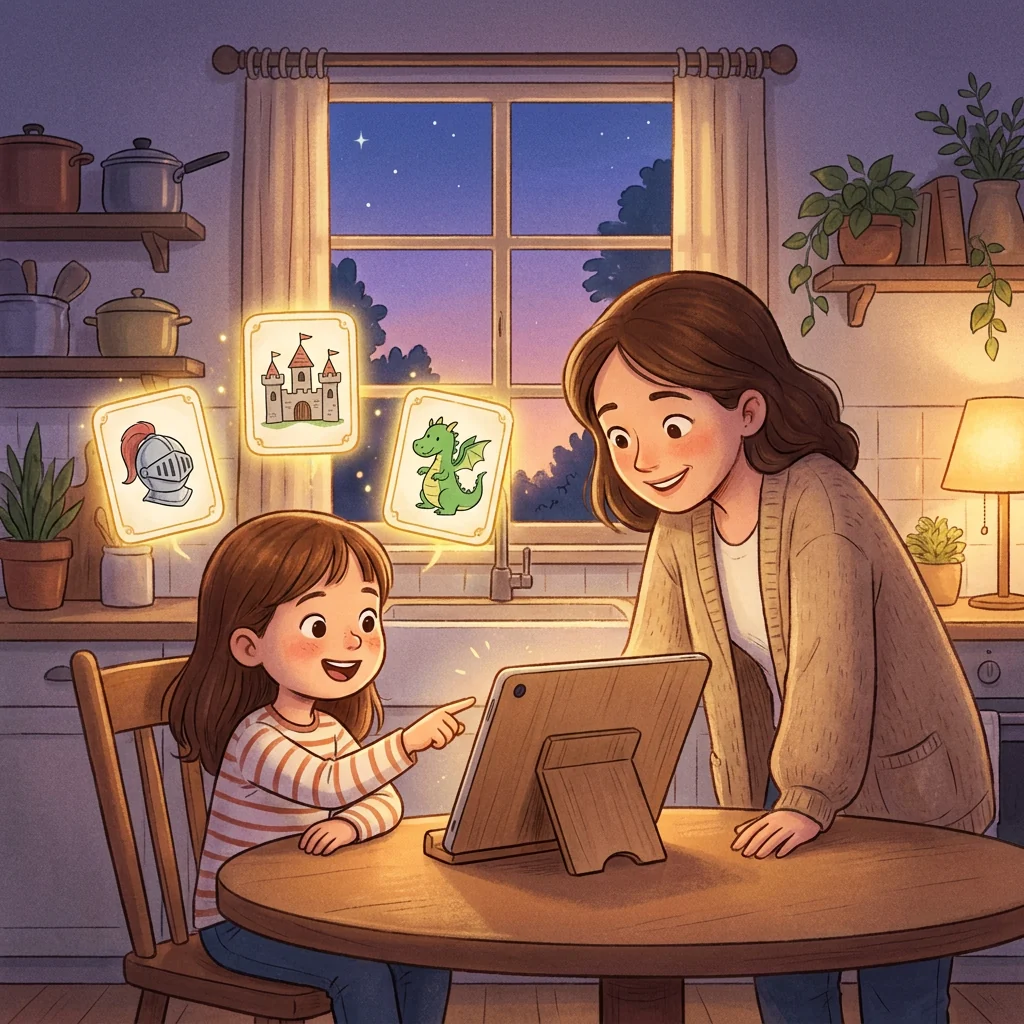
That last part matters for AI apps. A story your child helped shape (picking the hero, the place, what happens next) taps into this effect more than a story that simply has their name dropped in.
Memory: children remember what's linked to themselves
Psychologists call it the self-reference effect: we remember information better when it's connected to us. A study in Child Development tested this with 4- to 6-year-olds across three experiments. Children remembered objects paired with a picture of themselves better than objects paired with another child, even when they weren't asked to think about the link (Cunningham et al., 2014).
A story where your child is the hero puts that effect to work. Plot details, story words and the lesson of the story are all tied to "me."
Vocabulary: new words stick better, especially with re-reading
In a study published in First Language, 18 preschoolers (average age just under 4) were read a picture book with both personalized and non-personalized sections, each containing unfamiliar words. The book was read twice, a week apart. By the second and third tests, children knew the words from the personalized sections significantly better than the words from the other sections, and repeated shared reading strengthened the effect (Kucirkova, Messer & Sheehy, 2014).
Two details are easy to miss. First, this was a shared reading: an adult read with the child. Second, re-reading helped. Saving a favorite AI story and coming back to it is worth more than generating a new one every night.
Pictures and sound that match the story can help understanding
A 2015 meta-analysis in Review of Educational Research pooled 43 studies with 2,147 children. Stories presented with technology gave a small extra boost to story comprehension and expressive vocabulary compared with traditional story reading. The helpful features were ones that matched the story, like animated pictures, music and sound effects. Interactive extras like hotspots, games and pop-up dictionaries tended to distract children instead (Takacs, Swart & Bus, 2015).
For parents, the takeaway is to judge an app by how well its pictures and narration support the story, not by how many buttons it has.
Where AI bedtime stories fall short
The same body of research is just as clear about the limits.
They don't replace reading together
The American Academy of Pediatrics (AAP) recommends shared reading from birth through at least kindergarten. It describes reading together as something that strengthens the parent-child relationship and builds "the foundation for healthy social-emotional, cognitive, language, and literacy development" (AAP policy statement, 2024).
Screens can quietly change what happens during reading time. In a study in Pediatrics, 37 parents read with their toddlers using print books, basic e-books and enhanced e-books. With e-books, parents and toddlers talked less, and their collaboration was lower. Parents also made more comments about the device itself (Munzer et al., 2019).
A larger meta-analysis of 39 studies (1,812 children aged 1 to 8) found that when a digital book was simply a print book on a screen, children understood the story less well. An adult reading a print book with a child did better than a child reading an enhanced digital book alone (Furenes, Kucirkova & Bus, 2021).
Personalization doesn't automatically fix this. Kucirkova reports that when her team compared digital books with and without personalized sections, they found no difference in word learning. She also notes that research on personalized books is still too limited to know for sure what works (Scientific American, 2021).
Screen time, and screens at bedtime
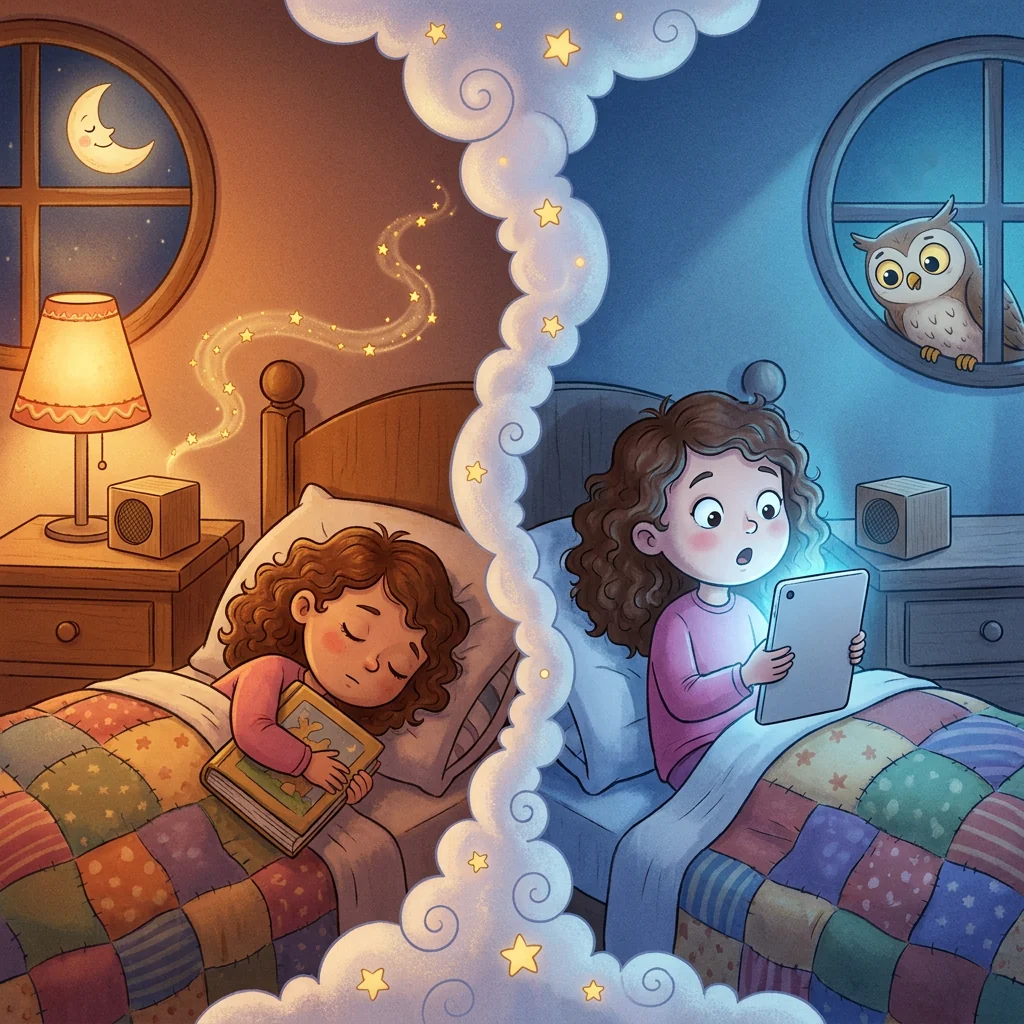
The AAP's guidance for children 2 to 5 is to limit screen use to 1 hour a day of high-quality content, used with a parent. It also advises no screens in the hour before bedtime and keeping devices out of bedrooms (AAP, Media and Young Minds). The AAP explains that screens can make children more alert and that screen light can disrupt melatonin, a hormone that helps with sleep (AAP, Screen Time Affecting Sleep).
This is the biggest practical tension with any bedtime app. The simple workarounds are to make the story earlier in the evening, to read it aloud yourself, or to switch to audio with the screen off and the device out of the bedroom. The AAP's 2026 policy update also asks families to think about what screen time crowds out, like sleep, reading, play and family time, and suggests keeping the hour before bed and bedrooms phone-free (AAP policy statement, 2026).
Odd pictures and text errors
AI makes things up sometimes. Common Sense Media explains that AI tools can "hallucinate," presenting something untrue as fact, and that even with safeguards they "can still produce inappropriate or harmful content" (Common Sense Media, Parents' Ultimate Guide to Generative AI).
In a bedtime story, that might look like a picture that doesn't match the words, a sentence that doesn't quite make sense, or a "fact" about animals that isn't true. And now and then it could be something you'd rather your child not see. That's why a quick read-through yourself, especially in the first few weeks, is still the best safety check. We cover the specific settings to look for in our how-it-works guide.
Over-reliance: when the app does all the imagining
There are two quieter risks.
The first is too much "me." Kucirkova notes that personalized books keep the focus on the child, while traditional stories help children step into someone else's shoes. In her studies, children mostly talked about their own feelings and experiences during personalized books, while parents steered the talk toward the other characters (Scientific American, 2021). A steady diet of stories about yourself can crowd out stories about other people, places and times.
The second is handing off the hard parts. The AAP advises against using media as the only way to calm a child, because it can get in the way of children learning to settle themselves (AAP, Media and Young Minds). Common Sense Media makes a similar point about creativity: AI works best when kids use it to kick-start their own ideas, not to do all the work for them (Common Sense Media). If the app invents every character, problem and ending, your child is only listening, not imagining.
How to get the benefits without the downsides
Put the research together and a clear pattern shows up. The benefits come from involvement, re-reading and talking together. The downsides come from solo screen use, late screens and passive listening.
- Make it together. Let your child choose the hero, the problem or the ending. Involvement is where the engagement effect is strongest.
- Re-read favorites. The vocabulary gains in the research came from repeated readings, not new stories every night.
- Talk about the story. Ask "What would you have done?" or "How do you think the dragon felt?" That turns a story about your child into practice thinking about others.
- Move the screen earlier. Make or preview the story at dinner time, then read it aloud at bedtime, or use audio with the device out of the room.
- Keep the bookshelf in the rotation. Mix AI stories with library books and old favorites so your child hears many voices, not just their own.
If your child likes being the one who decides, compare apps that let kids steer the story in our guide to the best AI story generators for kids.
When to use it, when to skip it: a checklist
Good times to use an AI bedtime story:
- ☐ Your child is facing something specific (a new sibling, a first swim lesson, a move) and no book on the shelf fits.
- ☐ Your child wants to be the hero, or wants to invent the story with you.
- ☐ You'll read it together or listen together, and talk about it afterward.
- ☐ You want a story your child will ask to hear again and again.
- ☐ You've read or previewed it first, or you're using an app built for kids with a parent area.
- ☐ You're traveling or apart, and an audio story keeps the bedtime routine going.
Times to skip it:
- ☐ It would mean a bright screen in the last hour before sleep, in the bedroom.
- ☐ Your child would be using it alone while you're in another room.
- ☐ It has already replaced most of your read-together time this week.
- ☐ Your child is a toddler. Print books read with a parent lead to more back-and-forth talk at this age.
- ☐ You haven't checked the app's safety and privacy settings yet.
- ☐ The app is a general-purpose chatbot rather than one designed for children.
Frequently asked questions
Are AI bedtime stories good for kids?
They can be. Research on personalized stories finds children are more engaged and learn new words more readily when a story is about them, especially when they help make it and it's re-read. The benefits are biggest when a parent reads or listens along, and smaller when a child uses a screen alone.
What are the benefits of personalized stories for children?
Studies link personalized books to higher engagement and motivation and to stronger learning of new words in the personalized parts of a story. Memory research also shows young children remember things linked to themselves better. Most of the reading research involves an adult reading with the child.
What are the pros and cons of AI bedtime stories?
Pros: endless variety, stories about your child's real situations, and a hero your child can help design. Cons: screen time close to sleep, occasional errors or odd pictures, and the risk of replacing shared reading or your child's own imagination.
Do AI bedtime stories count as screen time?
Yes, when your child is looking at a screen. The AAP advises no screens in the hour before bed. Read the story aloud yourself or use audio with the device out of the bedroom to avoid that.
Should AI stories replace reading print books?
No. The AAP recommends shared reading from birth through at least kindergarten, and studies find parents and toddlers talk more with print books than with e-books. Treat AI stories as one part of a bedtime routine that still includes real books.
Make a story together tonight
Magical Stories is built for kids who want to help write the story, not just hear it. Your child designs a hero, keeps them in a saved character library, and picks what happens at each stage. Then read it together. Create your first magical story →